Do You Need to Speak French in Paris? Honest Thoughts From an English-Speaking Local (2025)
Replanted in France contains affiliate links and is a member of the Amazon Services LLC Associates Program. If you make a purchase using one of these Amazon links, I may receive a commission at no extra cost to you. Read my privacy policy for more information.
You might be wondering if you actually need to speak French before you come to Paris – keep reading for my honest opinions!
I first moved to Paris in early 2024 speaking, essentially, no French at all. I was absolutely A0 – a term I learned from my A1 professor for someone who functionally speaks and understands about 0% of the French language. Big issue, I know.
My A0 existence lasted for my first six months or so in Paris, during which time I often asked people to speak in English with me. When they wouldn’t or couldn’t, I relied on friends or bystanders for help translating, or, if all else failed, Google Translate. This worked most of the time, as long as I could keep my cool.
I’ve since learned that my experience is somewhat typical in Paris, though I’ve since enrolled in French classes and just passed my A2 exam. Still, I know that people visit and move to Paris for a variety of reasons, and with a wide range of backgrounds. In this post, I’ll give my honest opinions and insights as I answer the question, “Do you need to speak French in Paris?”
Do You Need to Speak French in Paris?
The true answer to this question is that it depends.
More specifically, it depends on who you are and what you’re doing in Paris (and what your goals are, etc.). There’s a different answer for tourists, those with jobs in English, and those looking to permanently settle in the city.
Those living in Paris will face more pressure to learn French, both from the demands of getting around the city and from locals who would like for immigrants to integrate into French society. In many sectors, the higher paying jobs with better working conditions require at least some ability to speak and write in French.
Still, I’d be lying to you if I told you that every person in Paris speaks French. Many don’t, many never learn, and still others are just passing through – so it is possible to get around with very little French (basically everyone can pick up the habit of saying bonjour, bonsoir, and merci).

Can You Get By With Just English as a Tourist?
Mostly yes, you can get by with just English as a tourist in France. If you’re visiting Paris for a short trip and just want to see the city, a few words or phrases will be helpful but they’re not strictly necessary. Most people who work with tourists in France will speak at least some English, so you should be able to get where you need to go without speaking French.
That said, people will almost invariably be nicer to you if you greet them with a friendly bonjour. You could also run into situations where you need to communicate with an official who doesn’t speak English, such as a policeman or someone working in the métro.
So, in most circumstances, for most visitors, you can navigate Paris with very minimal French. That’s not a guarantee, however, that you couldn’t run into some situation that is significantly harder to navigate because of the language barrier. That’s a risk of travel!

How Much French Do You Need to Live in Paris?
I don’t believe that it’s essential for you to learn French before you move to Paris. I know many people who have come to the city without speaking a word of French – in fact, I met many of them in my A1 French class!
Still, coming without knowing French and not learning French are two entirely different things.
France is a French-speaking country, so it’s very important to the locals that you learn some French and be able to navigate the language at least on a basic level. English is treated like a second language in France, as opposed to a universal language like you might see in Germany or Scandinavia.
Speaking French is your key to integrating as a foreigner. It’s not the only thing you’ll need to do, but it’s almost impossible to integrate without it.
Despite the benefits of knowing French, such as increased ease of daily activities, integration, and being a respectful immigrant – not everyone learns the language. I know of many expats and immigrants who have been getting around for many years with just basic French and mostly English, particularly if their work takes place in English.

What Each CEFR Level Means (A1, B1, B2)
You may have heard me (or someone else) mention their level of French using a term like “C1” or “B2” and had no clue what they were talking about. If so, you’re not alone – I learned the system after moving to France.
Proficiency in many European languages, including French, are measured on the Common European Framework of Reference for Languages (CEFR) scale. The CEFR runs from A1 to C2, with A1 being the most basic level and C2 representing the highest level of proficiency.
While “A0” is sometimes used informally to describe someone with no knowledge of the language (like me when I moved!), the official scale starts at A1. Each level (A, B, and C) has two sublevels. So here are all the possible levels of French that you can have:
A1 (beginner) – You know basic phrases and can introduce yourself.
A2 (elementary) – You can handle simple conversations and everyday situations.
B1 (intermediate) – You can manage most travel situations and express opinions.
B2 (upper intermediate) – You can speak fluently and discuss complex topics.
C1 (advanced) – You’re comfortable in professional and academic setting
C2 (proficient) – You have near-native fluency and understand subtle nuances.
If you don’t know your exact level, don’t worry too much. Most any French class you take will start with an assessment of your current level and skills to ensure you start at the right level.
How to Start Learning French Before (and After) You Move
The easiest and lowest barrier-to-entry way to learn French is to start with a language learning app on your phone. However, you can augment your learning by including some immersive methods like watching TV or listening to podcasts in French. Last, but certainly not least, is a traditional classroom, where you can learn grammar basics in a straightforward way, usually with a native speaker.
My Top App Picks
There are dozens of apps on the market for learning languages, from Rosetta Stone to Duolingo to Babbel. Each has a slightly different value proposition and targets a different kind of learner. For the purposes of this post, I want to recommend two that I have personal experience with: Duolingo and RocketFrench.
Duolingo (Free with Paid Upgrades)
By far the most popular is Duolingo, a heavily gamified app with an iconic green owl for a mascot. Duolingo is designed to keep you coming back day after day – it’s where I started learning French, and it’s a great way to get started!
I found Duolingo to be helpful for learning some new vocab and encouraging me to feel committed to learning French. After a while, though, I knew that I wanted something more structured, so I moved on to a paid tool.

RocketFrench (Paid)
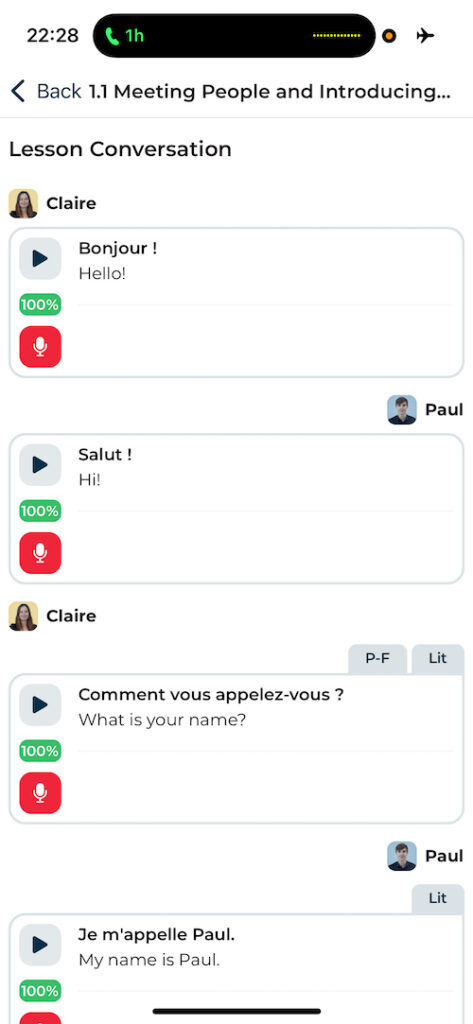
I bought RocketFrench when I noticed I wasn’t making substantive progress with my French, but I was ready to get serious about language learning after spending hours on Duolingo. I chose this platform because I read great reviews and I really liked the lessons in the free trial, which included a mix of lesson types and content.
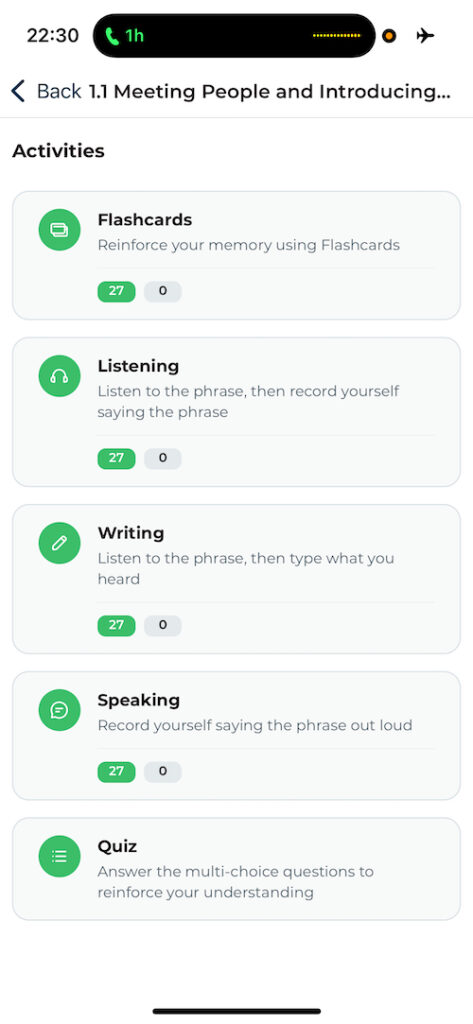
Although the lessons in RocketFrench will not grab and hold your attention like Duolingo, I still love it for learning French. The lessons are structured like an interactive textbook, with a mix of listening, speaking, flashcards, and writing for each. I especially like the option to listen to an example, record yourself speaking with feedback, then listen to both recordings to perfect your pronunciation.
In my in person classes, I was consistently stronger in the grammar concepts and vocabulary lessons that I’d practiced on RocketFrench when compared to my peers using just the class homework or those who also practiced on Duolingo. When people asked me how I did it, I always told them my secret: RocketFrench.
Immersive Learning
Whether you’re just getting started or working through some sort of program, you can easily augment your learning by consuming some French media. Then, once you’re in Paris, you can incorporate some in person events that are in French. This sort of immersive learning can help you to learn casual vocabulary, get practice speaking, and sharpen your listening skills.
Here are a few resources that I have used and loved while learning French:
InnerFrench is a long form podcast with topics like culture, news, and current events. Best for intermediate learners.
The Duolingo French Podcast covers topics in French culture, history, and stories about the daily lives of some French speakers. My favorite series is “The Secret Life of Josephine Baker” which tells the story of an American dancer who finds herself working as a spy during World War II.
Call My Agent (“Dix Pour Cent”) is a drama series on Netflix about a talent agency run in Paris.
Streaming services like Netflix, Hulu, and Max (or whatever they’re calling themselves these days) often have options to turn on French subtitles or dubbed audio. I often watch shows I already like in French – but animated kids movies are also great practice because the dialogue is simple and easy to follow.
Exercise Classes in French have also been a great way to get some practical listening experience. I use ClassPass to book exercise classes in Paris – I usually opt for yoga but the app has boxing, Pilates, spin, and a number of other options. If you’re wondering, my favorite yoga studio in Paris is Beyoga in the 14th.
Where Can You Study French in Paris?
If you’re coming to Paris without speaking much, if any, French, you won’t be alone. Every year, students come from around the world to study French and, as you might expect, figure it out as they go. You’ll have a lot of options for classes if you decide to go that route, but here are the two most popular options: the public classes through the city of Paris and Alliance Française.
Local Mairie
For those living in Paris, your local Mairie or town hall is one of the best and most affordable places to learn French. There are half time classes (four hours/week) or intensive classes (eight hours/week) and they’re taught by mostly great instructors. So far, I have taken an A1 (intensive) and A2 (intensive) course, as well as a speaking workshop that meets two hours per week.
Because demand for these classes is high, they can be hard to get into each semester. Although no one really knows the secret to being accepted, it’s generally understood that it’s smart to apply as early as possible when the application window opens and to include a thoughtful (and short) essay about why you want to take the course in your application.
You can see the upcoming course catalog and register for classes here.

Alliance Française
For those who don’t take classes through the mairie, the most popular classroom option is Alliance Française, a staple in the world of French language teaching. I have a friend who has taken several intensive courses and swears by their teaching method, which she touts as faster and more efficient than any other language program she’s tried.
Depending on where you live, you may be able to start taking classes with Alliance Française in your city in the US!
Private Tutors
Although it’s not a classroom, many people in Paris swear by having a private tutor. By far the most popular tutor matching service is Preply, where you can get matched with a French speaker to help you improve your pronunciation, confidence, or overall skill level. You can also search for tutors who speak your native language, which can be helpful for explaining grammatical concepts that don’t have exact translations in English.
Is French Hard to Learn?
First: it’s a big challenge to learn a new language, regardless of how “hard” the language is to master! But to put French in context, the US Department of State lists French among the easiest languages for English speakers to learn and reach fluency. The State Department estimates that it takes about 690 classroom hours for an English speaker to become proficient in the language.
Compare that to German, for instance, which is a category II language. The State Department estimates that it will take approximately 828 class hours for an English speaker to learn German. Finally, there are category IV languages like Arabic, Mandarin, Japanese, and Korean. It’s estimated that these languages take 2,200 class hours to master.
So, while French is definitely a tricky language, it’s definitely doable for English speakers!

Why French is Tricky
For anyone just getting exposed to French, there are a few ways that this language can really trip up learners.
First, there are a number of silent letters. We have silent letters in English, but this practice is much more common in French. Take vous, for example – the formal version of “you.” This word is pronounced “vou” (rhymes with “two”).
Second, there are “faux amis” or words that look similar in English but have different meanings. Librarie is French for “bookstore,” while bibliothèque means “library.” You can probably see how this could get confusing!
Third, among many others, is that French (like Spanish) has gendered nouns. While some are easy to guess, there’s no particular reason I can see that le chocolat (chocolate) is masculine while la porte (door) is feminine!
Still, practice makes better. The more familiar you get with French, and the more you practice, the easier these – and other – rules will seem.

Tips to Stay Motivated
The trick to staying motivated when learning a language, I believe, is to:
1. Develop an identity as someone who is learning French, and
2. Make language learning a part of your daily life.
The best book I’ve read about forming new habits is Atomic Habits by James Clear, and he explains these concepts in a detailed way that is easy to follow.
Try to find ways to incorporate French into your daily routine, whether it’s finding a song in French that you enjoy and try to sing along to in the shower or a TV show that you watch with subtitles on. The more you can expose yourself to the language and, even better, native speakers, the easier it will be to stick to your goals.

How Long Does it Take to Be Fluent in French?
There’s no clear predictor of how long it will take you to be conversational in any language, and French is no exception. The total time you’ll need is influenced by factors like how quickly you learn and how much time you can dedicate each week.
I’ve heard language teachers estimate that you can become proficient in French after about a year of practice following the completion of B2. They prefer proficiency to fluency because it has a more concrete definition: the ability to handle most conversations and situations you encounter.
Meaning, you can talk about yourself in a job interview or have a conversation with a friend. However, even if you’ve reached proficiency, you might still struggle with more specialized vocabulary like at an automotive shop or when speaking with an electrician.
Using this definition of proficiency and my own learning rate of one level per semester (assuming two semesters/year), I would estimate that it would take a focused learner about three years to become proficient in French.
Must-Know French Phrases Before You Move
The list of words and phrases you absolutely need before visiting Paris is short, but I would recommend that you memorize them before you head over.
- Bonjour – this translates to “Good day” but it’s essentially the social key to most any interaction with someone in France. For bonus points, you can also say “Bonsoir” or “Good evening” after 6pm. But don’t worry – if you can only remember one, people will know what you mean if you use “bonjour” at night.
- Parlez-vous anglais? – “Do you speak English?”
- Où sont les toilettes? – “Where are the toilets?” It sounds a little crude in US English, but “toilets” is more common in Europe than “bathroom” or “restroom.” Often, the bathrooms will be marked with a WC for “water closet” but I’ve never heard anyone actually say the term when speaking, “toilettes” is much more common.
- L’addition, s’il vous plaît – the most common way to ask for the check at a restaurant.
- Merci – “thank you”
Of course, this is a very short list of the phrases and words you’ll want to know before moving to France. If you’d like a longer, more comprehensive list, download my free Expat Survival Guide!
FAQs: Do You Need to Speak French in Paris?
Considering visiting or moving to Paris and still not sure if you need to speak French before you get here? Here are the answers to some common questions from other travelers.
Is it okay to speak English in Paris?
If you visit Paris, chances are you’ll hear English and a mix of other languages being spoken on the streets and in the restaurants. It’s perfectly fine to speak English – it’s an international language. However, it’s considered polite to at least address the people you meet in French, even if you switch to French after all.
Can you survive in Paris without knowing French?
There are people who live for many years in Paris without knowing French, so it is possible. I met someone the other week who had been in France for 8 years and was in A2 with me. However, surviving isn’t necessarily thriving; I would encourage you to start learning French as soon as you can.
There are also some administrative and logistical situations (like when you need to call a plumber) when it’s really advantageous to speak some basic French. Can you use Google Translate to get by? Sure, but it would be better to be able to have these basic conversations in French.

Is it important to know French in Paris?
Yes, it’s important to know French in Paris. Even tourists should learn a few simple words, like bonjour and merci, because they’re in France and people speak the French language. Still, it’s perfectly fine to be learning French in Paris and to not have a complete grasp on the language.
Is it rude to ask if someone speaks English in France?
No, it’s not rude at all to ask if someone speaks English when you’re in France – especially if you ask in French (if you can). Be aware that, depending on the sector, they might say “no” because many French people don’t speak English – particularly if they don’t work with tourists and/or foreigners on a regular basis.
To ask if someone speaks French, say, Excusez-moi, parlez-vous anglais? Most of the time they’ll say “Yes” and continue speaking to you in English for the rest of the conversation.
Conclusion: Do you Need to Speak French in Paris?
Tourists who are visiting Paris should be perfectly fine getting around with just a few words – there’s certainly no need to be fluent in French beforehand. Even if you didn’t try to speak French at all, you can typically convey enough politeness in English to get by for a visit.
Those living in Paris should commit to learning the language as soon as practicable, especially if you’ll be relocating permanently. Speaking French in France is the clearest indication to locals of your willingness to integrate, your respect for French culture, and your dedication to living here long term.
Bon courage pour apprendre le français !